

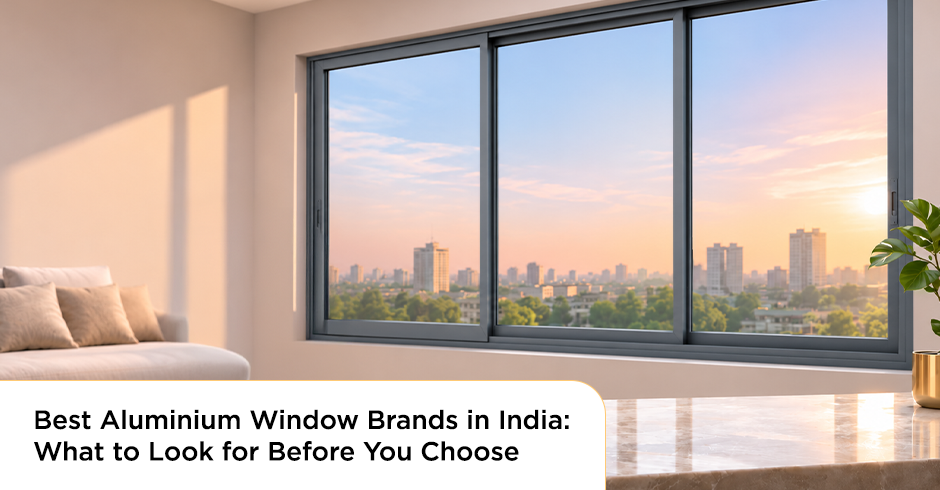
You are in a showroom, and the three windows look almost the same. One costs more than the others. What exactly is the extra money buying?
The answer sits in details you cannot see from the shop floor: the frame metal, its finish, the glass and the seals around it. Aluminium and uPVC windows and doors are two popular choices, and each has strengths the other lacks.
Frame, Finish, Glass and Seals: What the Best Aluminium Window Brands Get Right
Anyone searching for the best aluminium window brands in India will find plenty of names and very little to tell them apart. Five checks cut through the noise:
- Finish: Powder coating (a baked-on paint layer) or anodising (a surface treatment for metal) protects the metal from rain and sun and helps the colour last, so ask which one the brand uses.
- Heat break: Bare aluminium passes heat easily, so a good frame has a plastic strip, called a thermal break, between the outer and inner metal.
- Glass: Ask whether double glazing is offered, since two panes with a gap between them help with both heat and noise.
- Seals and hardware: Rubber seals keep out dust and rain, while sturdy hinges, handles and rollers decide how the window feels after a few years.
- Support: A brand that fits the window and answers when something sticks is worth more than a glossy brochure.
Heat, Noise and Upkeep: uPVC Windows vs Aluminium Windows
Put uPVC windows vs aluminium windows side by side, and the gap shows up in three places. In terms of heat, uPVC does not conduct heat easily, so the frames tend to stay cooler in summer. Aluminium can be similar but will need a proper thermal break. Noise is somewhat different. Both can be good at blocking sound if the seals are tight and the glass is good. Often the quality of installation is more important than the frame material.
Aluminium wins on strength. That lets the frame stay slim and the glass panel grow large, which is why many buyers pick it for wide openings. A fair look at uPVC windows vs aluminium windows therefore has no single winner, only a better fit for each wall. It is also why the best aluminium window brands in India should be able to tell you honestly where uPVC would suit you better.
Comparison Factor | uPVC Windows | Aluminium Windows |
Heat Insulation | Does not conduct heat easily, helping frames stay cooler during summer. | Can offer similar insulation when equipped with a proper thermal break. |
Noise Reduction | Can effectively block sound with quality glass and tight seals. | Also offers good sound insulation with quality glass and tight seals. |
Installation Quality | Proper installation plays an important role in noise reduction. | Proper installation plays an equally important role in noise reduction. |
Strength & Design | Suitable for standard window designs and openings. | Offers greater strength, allowing slimmer frames and larger glass panels, making it ideal for wide openings. |
Overall Suitability | A good fit where thermal insulation is a priority. | A better fit for larger openings and designs that require slim, strong frames. |
Which Room Needs Which Window?
Think of a bedroom that faces a busy road. Keeping the noise out is the main concern, so either uPVC or aluminium can work well if the windows have tight seals and double glazing.
A west-facing hall has a different problem. It gets hot in the afternoon, and a uPVC frame or aluminium frame with a proper thermal break can help keep some of that heat outside. For a wide balcony opening, though, aluminium has an advantage. It is strong enough to support a slimmer frame, leaving more space for the view.
Kitchen windows get steam and splashes, so they need a finish that handles damp. Both aluminium and uPVC windows and doors can manage that when the finish and the seals are good, and the look you want can settle the choice.
Where uPVC Windows and Doors Make the Most Sense
Bedrooms, living rooms and everyday spaces are where uPVC windows and doors earn their keep, since they need no painting and have seals built in to hold back dust and rain. Because the design can be made to order, a window can also be sized to fit an odd opening instead of forcing the wall to fit the window. The style matters as much as the material. A sliding window saves space where a swinging one would hit a wall. Casement windows open fully for fresh air. Tilt-and-turn windows tilt open a little for gentle airflow or swing wide when you want to clean the glass.
What Sudhakar Builds for Windows and Doors, in Aluminium and uPVC
We have been making PVC products since 1971, and we supply both types of windows through our authorized channel partner network. Our Sudhakar FrameX aluminium windows and doors are designed for tough weather and easy installation, with surface and colour protection and sound insulation. Our uPVC windows and doors come in sliding, casement, bay, tilt-and-turn and combination styles across the ECO, PRIMA and ROYAL series, and they are dust proof, noise cancelling, weather resistant and low on upkeep. As an ISO 9001:2015 company, we can also match designs to your home or office.
FAQs
How Do I Spot the Best Aluminium Window Brands in India?
Check the frame finish, a thermal break, glass options, the seals and the after-sales support.
Are uPVC Windows and Doors Good Near a Noisy Road?
They can help cut road noise when they are fitted well with tight seals and the right glass.
What Is a Thermal Break?
It is a plastic strip inside the aluminium frame that slows heat travelling from outside to inside.
Do Aluminium Windows Need Painting?
Powder-coated or anodised frames need no regular painting, only cleaning.
Explore our latest Blogs
Smart Reasons to Upgrade to Premium uPVC Windows and Doors for Noise-Free Living
How to Choose the Right uPVC Windows for Your Home?
Latest uPVC Window Design Trends for Modern Homes
7 Reasons Builders Prefer Aluminium Doors and Windows for New Projects