

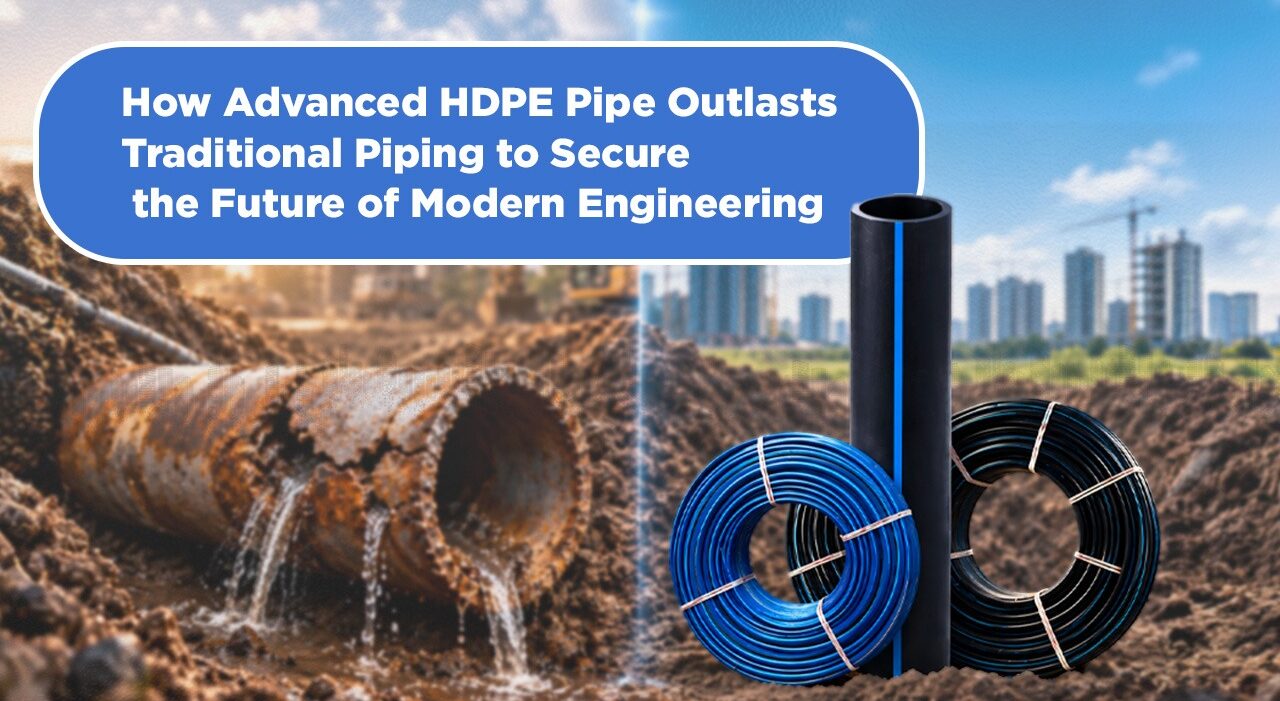
Why do some underground pipelines continue working for decades while others require frequent repairs? The answer often begins with the material chosen for the project.
An HDPE pipe is designed to handle demanding conditions such as ground movement, moisture and chemical exposure. Made from high-density polyethylene, it offers a combination of flexibility, strength and corrosion resistance that makes it suitable for water supply, irrigation, sewage and industrial applications.
For projects where long-term reliability matters, consider the material and its specifications from the start.
What Makes an HDPE Pipe Different From Traditional Piping?
Steel and cast iron have been used in piping for years, but they can corrode when exposed to moisture, chemicals or harsh surroundings. HDPE is different because it does not rust or corrode. This is particularly useful for underground pipelines, where pipes may stay out of sight and are difficult to access for years.
HDPE is also more flexible than rigid metal pipes. It can bend to a certain extent and accommodate some ground movement, which can be useful in underground installations. And because it is much lighter than most metal pipes, it is easier to transport, handle and install.
Of course, no single pipe material works for every application. But when you need a pipe that is lightweight, flexible and resistant to corrosion, HDPE can be a practical choice for many infrastructure and industrial applications.
HDPE Pipe vs Traditional Piping Materials
Factor | HDPE Pipe | Cast Iron / Steel Pipe |
Corrosion | Does not rust or corrode | Prone to rust over time |
Weight | Lightweight (specific gravity ~0.94-0.96) | Considerably heavier |
Flexibility | Flexes under ground movement | Rigid, prone to cracking |
Chemical resistance | High, suited to acids and gases | Limited, can degrade with exposure |
Jointing | Heat-welded, leak-proof | Often bolted or threaded, more joints to maintain |
Typical lifespan | Several decades with proper installation | Shorter, especially in corrosive conditions |
How Strong Is a High Density Polyethylene Pipe?
Strength is one of the reasons high density polyethylene pipe is used for demanding applications. Its performance depends on factors such as the polyethylene grade, wall thickness, diameter, operating temperature and pressure rating.
HDPE also has good impact resistance compared with more brittle piping materials. This allows it to withstand handling and certain external stresses without shattering easily.
However, pipe selection should always be based on the actual requirements of the project rather than strength figures alone. Pressure, temperature, installation conditions and the fluid being carried all need to be considered.
How Do HDPE Pipe Manufacturers Ensure the Right Pipe Is Selected?
Different projects require different grades and pressure ratings. Established HDPE pipe manufacturers therefore offer pipes in different material grades and dimensions to suit specific applications.
PE-63, PE-80 and PE-100 are commonly used polyethylene grades, with PE-100 offering higher strength that can allow a thinner wall for a given pressure requirement compared with lower-grade materials.
The correct choice depends on factors such as operating pressure, pipe diameter, temperature and application. Engineers should refer to the relevant standards and manufacturer specifications before selecting a pipe.
Where Are HDPE Water Pipe Fittings Used?
HDPE pipes and fittings are used in many places where water, wastewater or other fluids need to be moved safely from one point to another. You’ll commonly find them in:
- Drinking water supply and irrigation systems
- Tube well suction and delivery lines
- Sewage and effluent networks
- Industrial fluid pipelines
- Gas distribution systems
- Underground cable ducting
The way HDPE pipes and fittings are joined depends on how the system will be used. Heat fusion is often used when a permanent connection is needed, creating a strong joint between compatible HDPE components. Flanged or mechanical connections are useful when the pipe needs to be disconnected later for equipment changes, inspection or maintenance.
Why Is HDPE Suitable for Industrial Applications?
Industrial pipelines often deal with demanding operating conditions, which is where the properties of HDPE become useful.
The material is resistant to corrosion and many chemicals, while its relatively low weight makes it easier to handle than comparable metal piping. Its flexibility can also be useful in installations where some ground movement is expected.
These characteristics make HDPE a practical option for applications involving water, wastewater, chemicals and other compatible fluids. The specific material grade and pipe specification should always be selected according to the substance being transported.
How Is an HDPE Pipe Installed?
Installation depends on the project, pipe diameter and site conditions. HDPE sections can be joined using heat fusion, creating a continuous pipeline with fewer mechanical joints.
The pipe is then placed in a properly prepared trench or installed using another suitable method. Its flexibility allows it to follow gradual changes in alignment, but correct trench preparation, bedding, jointing and backfilling remain important for long-term performance.
A good pipe cannot compensate for poor installation, so following the manufacturer’s installation guidelines is essential.
What Determines HDPE Pipe Price Per Meter?
The price of an HDPE pipe can vary depending on several factors, including its diameter, wall thickness, pressure rating, polyethylene grade and the quantity being ordered.
But price is only one part of the decision. It’s important to first understand what the project needs in terms of pressure, flow and operating conditions. A lower-priced pipe may not be the right fit if it cannot handle the demands of the system.
If you’re planning a larger installation, asking for a project-specific quotation can make things easier. It gives you a clearer idea of the pipe quantities, fittings and other materials you’ll need.
Sudhakar HDPE Pipes for Infrastructure and Industrial Applications
Sudhakar manufactures HDPE pipes in PE-63, PE-80 and PE-100 grades, with sizes ranging from 20 mm to 630 mm. The range is manufactured to applicable standards, including IS 4984:2016, for applications such as water supply, irrigation and industrial requirements.
With different grades, sizes and pressure ratings available, the right Sudhakar HDPE pipe can be selected according to the requirements of the project. Sudhakar also offers compatible HDPE water pipe fittings to help complete the piping system.
For product specifications or project requirements, contact Sudhakar on 1800 120 000 066 or write to info@sudhakarind.com.
Frequently Asked Questions
What is the typical lifespan of an HDPE pipe?
With correct selection and installation, HDPE pipes are designed for several decades of service.
How is a high density polyethylene pipe different from PVC?
HDPE is generally more flexible and impact-resistant, while PVC is more rigid and has different application requirements.
Why are HDPE pipes available in different pressure ratings?
Different pressure ratings allow pipes to be selected according to the working pressure and requirements of a particular system.
What is the preferred jointing method for HDPE pipes?
Heat fusion is commonly used for permanent HDPE joints, while mechanical connections can be useful where disassembly may be required.
What are HDPE water pipe fittings used for?
They connect pipe sections, change the direction or size of a pipeline and help connect the pipe network to other equipment.