

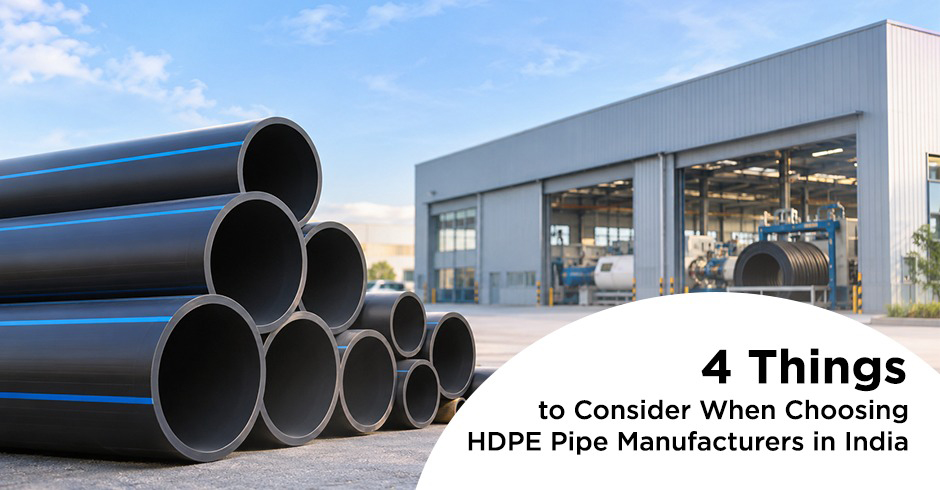
Once a pipe goes into the ground, nobody looks at it again until water stops reaching the tap, the farm or the factory line. That is why the choice made before the trench is dug matters more than any repair made after.
HDPE stands for high-density polyethylene, a tough plastic that bends a little without breaking. An HDPE pipe can carry drinking water, water for crops, wastewater and even some chemicals. Plenty of HDPE pipe manufacturers in India sell it, and the pipes can look alike from the outside, so it helps to know what to ask before you buy.
Check the Standard and the Pressure Rating First
A good pipe is made to follow an Indian Standard. For water supply, look for IS 4984:2016, while IS 14151 covers sprinkler irrigation. A manufacturer that follows the standard can tell you the number straight away.
Two more numbers matter. Grades come first, such as PE-63, PE-80 or PE-100, and the higher the number, the stronger the plastic. Next is the PN rating, which is the pressure, counted in a unit called bar, that the pipe is built to take, so a PN10 pipe is made for 10 bar. It is wise to pick a rating a little above the pressure your line will really see. A line that runs at 6 bar, for example, sits more comfortably on PN10 than on PN6. Ask which grade and PN rating suit your job before you ask about the price.
Match the Sizes and the Form to Your Job
A farm may need long stretches of thin pipe, while a town water supply usually calls for wider pipes in fixed lengths. Smaller pipes often come in coils, so there are fewer joints along a long run. Larger pipes are generally supplied in straight lengths.
Before choosing, work out how many metres the job needs. For a long run with a smaller pipe, coils are usually more practical. For a shorter run using a wider pipe, straight lengths may make more sense. It helps when one manufacturer offers both options, so you can keep the same brand throughout the project.
The Sudhakar range is a good example of what a complete selection looks like:
Colour | Sizes | How it comes |
|---|---|---|
Blue | 20 mm, 25 mm and 32 mm | Coils of 300 to 500 metres |
Black | 20 mm to 110 mm | Coils of 50 to 500 metres |
Black | 140 mm to 630 mm | Straight lengths of 6 and 12 metres |
Ask How Every Batch Is Tested
Rules on paper are not enough. Ask whether the maker has its own testing lab, whether each batch is tested, and whether it will share the test report with you. When the pipes arrive, check that the batch number on the report matches the batch number on the pipes. An ISO 9001:2015 certificate shows that the way a company works is checked by external auditors, but it does not replace tests on the pipe itself.
You can also check the pipe with your own eyes. The surface should feel smooth, the colour should look even from end to end, and the ends should be cut clean.
What to Expect From HDPE Pipe Manufacturers on Joints, Supply and Support
A pipeline is more likely to leak at its joints than along the pipe, so ask which joining methods the maker supports. The common ones are heat welding (melting two ends together), electro-fusion (a fitting with a heater built in) and flanged joints (two plates bolted together). Also ask where the pipes are made, how they reach your site and who you call if something goes wrong after the pipes are laid. A written delivery date helps too, since a crew waiting for pipes costs money every day.
Last, compare the price list the way a site engineer would. Ask for the catalogue as well, so the sizes, grades and prices sit side by side. A pipe that costs a little less per metre can cost much more once joints, repairs and delays are counted, which is why the cheapest quote is not always the cheapest job.
Where Sudhakar Pipes Stand on Standards, Sizes, Testing and Support
We have made pipes since 1971, and our HDPE pipes follow IS 4984:2016 for water supply. They come in PE-63, PE-80 and PE-100 grades with ratings from PN2 to PN20, in sizes from 20 mm to 630 mm. Our plants in Suryapet in Telangana, Ganjam in Odisha and Nellore in Andhra Pradesh can make up to 48,000 tonnes a year, and each batch is tested to the BIS scheme before it leaves. Our dealers supply to Telangana, Andhra Pradesh, Karnataka, Tamil Nadu, Maharashtra, Chhattisgarh and other states. As one of the HDPE Pipe Manufacturers in India with over 50 years of experience, we keep our catalogue and price list on our website, so sizes and costs are easy to compare.
FAQs
What Does PN10 Mean on an HDPE Pipe?
It means the pipe is made to carry water at up to 10 bar of pressure.
What Is the Difference Between PE-63, PE-80 and PE-100?
The number shows the strength of the plastic, so PE-100 is the strongest of the three.
Should I Pick Coils or Straight Lengths?
Coils suit long runs of small pipe, while straight lengths suit wide pipe.
What Should I Ask HDPE Pipe Manufacturers Before Ordering?
Ask for the standard, the grade, the pressure rating and the latest batch test report.